

For luxury and high-value stores
Secure AI payments: stop fake agents, scams and chargebacks
Securing AI payments means three checks on every agent order that matters: the agent is who it says it is, a real person authorized this purchase, and that person is verified and allowed to buy it. Payment tokens protect the card. Verification protects you from the person behind it.
deepidv does not process payments. Your payment provider moves the money. deepidv proves who is on the other end: the agent, the person who authorized it, and whether they are allowed to buy.
How stores get robbed through AI checkout
Stores that sell through AI checkout face six fraud patterns. Some fake the agent, some trick a real one, and some come from the person behind the order.
- Impersonated agents. Fraud traffic copies the name of a known AI agent and skips its signature. Treat an agent name with no valid signature or other proof of identity as a bot.
- Agent carding. Automated agents can test stolen cards against live checkouts at a speed no human tester could match.
- Prompt injection. Hidden text on a page, review or product feed tells an agent to add items or trigger a refund. Palo Alto Networks' Unit 42 has described how attackers could hijack an agent's return flow.
- Synthetic buyers. AI builds believable customers with a face, an ID, an email and a phone number to farm welcome offers and run up orders before disappearing.
- Agent friendly fraud. A customer disputes the order and says the agent bought it without permission.
- AI-forged return evidence. Generated photos of damage or a wrong item, sent to win a refund.
Why luxury stores are hit first
One bad luxury order costs many times what a bad order costs elsewhere. Resale markets turn stolen goods into cash within days, and returns can swap a real item for a convincing fake. Criminals also build cloned storefronts with your brand's name and images; shoppers' agents searching for the lowest price can land on them.
The three-check model
An agent order that matters needs three separate checks: the agent, the authorization and the person. Card networks and platforms cover the first two; the third needs verification of the person.
| Check | What it proves | Comes from |
|---|---|---|
| Agent identity | The request came from a registered agent and was not altered | Signed requests, network agent directories, platform agent profiles |
| Authorization | The person approved this cart or spending limit | Network mandates and passkeys, wallet approvals |
| Person and eligibility | Who the person is, that they hold one account, and that they may buy this | deepidv: ID and live face, 1:N match, phone signals, age and sanctions checks |
Swipe the table to see every column.
Set rules by order risk
Match the check to the risk of the order: returning verified customers keep a fast agent checkout, and new or unusual orders get a closer look.
| Order | Rule |
|---|---|
| Returning verified customer, normal basket | Agent checkout, no new check |
| New customer above your value threshold | ID and live face before capture |
| New device or shipping address on a high-value order | Face check against the customer's earlier verification |
| Limited release | Verified customers only, one per person |
| Return claim above your threshold | Face check before refund |
Proof that holds up in a dispute
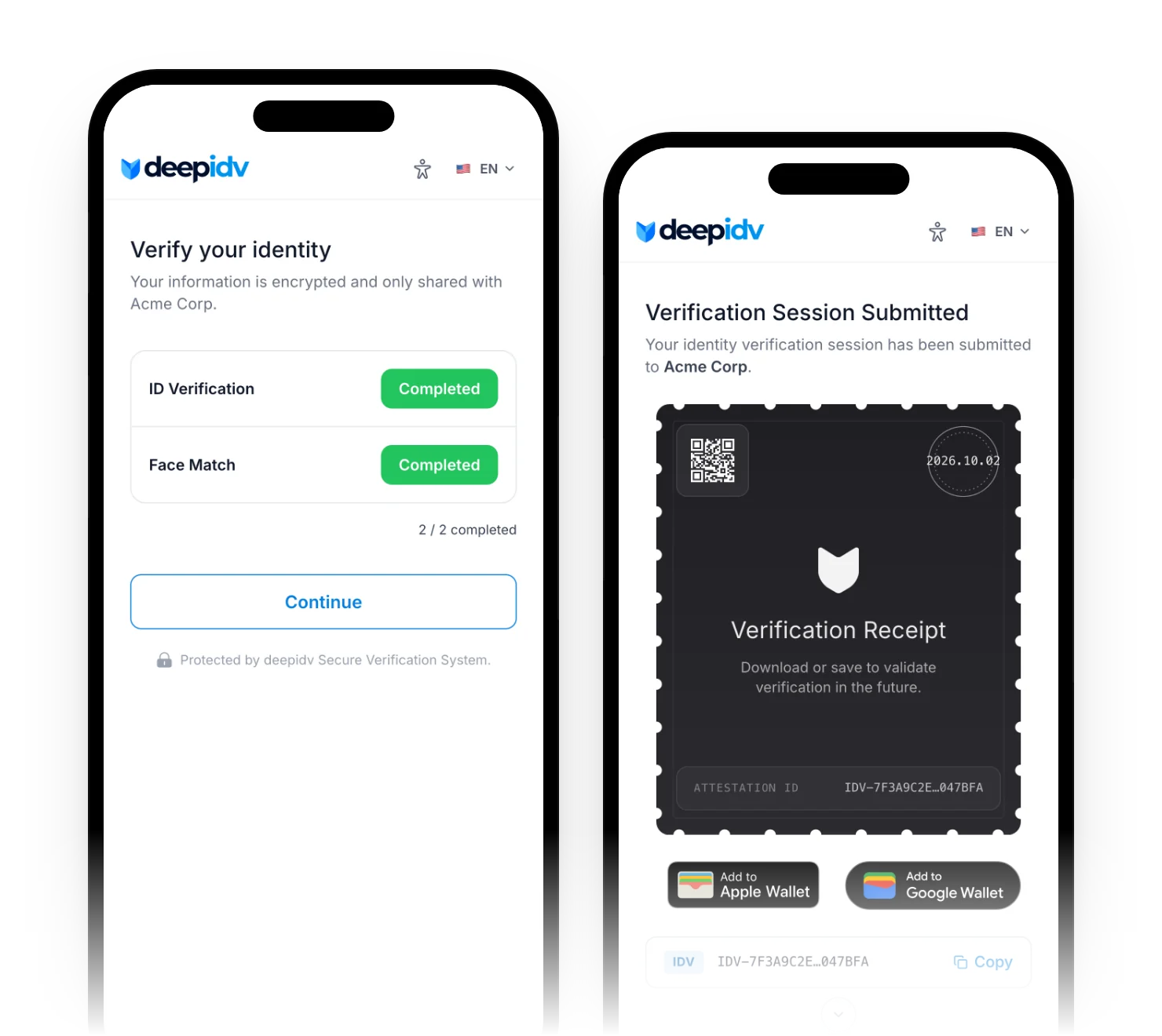
Every deepidv check produces a signed receipt with a timestamp for each step, anchored on Base L2 with zero personal data on chain and checkable by anyone at proof.deepidv.com. Attach it to the order. When the customer says they never authorized the purchase, you can show who verified, when and how.
Watch every account after the first order
Arbiter, deepidv's compliance agent, monitors transactions and behavior after onboarding: sudden spending changes, new devices, linked accounts. It flags them for review before the next high-value order ships.
Add verification to your Shopify store
The deepidv app for Shopify adds verification to your store without code. Choose when it runs: first orders, orders above a value you set, limited releases, age-restricted products, or agent orders your rules flag. Customers verify once with ID and a live face check, and their later orders, including those placed by their AI agent, reuse the result. Every check produces a signed receipt you keep with the order.
- ID and face verification
- One person, one account
- Age checks without an ID upload
- A receipt for every check
Frequently asked questions
How do I secure AI payments in my store?
Check the agent's signature or token, keep the person's authorization mandate, and verify the person on high-value, first and limited orders with ID and a live face check. Store a receipt with each order.
What is agent carding?
Fraudsters using automated agents to test stolen card numbers against real checkouts. Velocity limits, signed agent traffic and person verification on new accounts help stop it.
Can an AI agent be tricked into overspending?
Yes, through prompt injection: hidden instructions on a page or feed. Merchants should strip hidden text from product data and confirm unusual baskets with the person.
Who pays when an AI agent order is disputed?
Usually the merchant carries the chargeback, though Visa's rules hold the cardholder responsible for purchases made by an agent registered with Visa. A verification receipt showing who approved the order is useful evidence to add.
Do Visa and Mastercard agent programs stop fraud on their own?
They prove the agent and the authorization. They do not check the person's ID and face, or whether one person controls many accounts. Pair them with verification.
Does verification slow down good customers?
No, if you verify once and reuse the result. A returning verified customer checks out through their agent with no new step.
Verify the person behind the orders that matter, and keep a record of every check.
Sources
- DataDome: The AI Agent Identity Crisis: 80% of Agents Don't Properly Identify Themselves, 80% of Sites Don't Verify (February 26, 2026)
- HUMAN Security: AI Crawler Spoofing Exposed: How Attackers Masquerade as ChatGPT, Mistral, and Perplexity (September 9, 2025)
- HUMAN Security: AI Agents and Fraud: Early Evidence of Carding Behavior in the Wild (December 9, 2025)
- Palo Alto Networks Unit 42: Who's Really Shopping? Retail Fraud in the Age of Agentic AI (March 20, 2026)
- American Banker: Payment giants battle the fear factor in agentic commerce (September 17, 2026)
- Visa: Visa Core Rules and Visa Product and Service Rules, rule 4.1.24.10 (ID# 0031176) on agentic transactions (April 18, 2026 edition, PDF)