

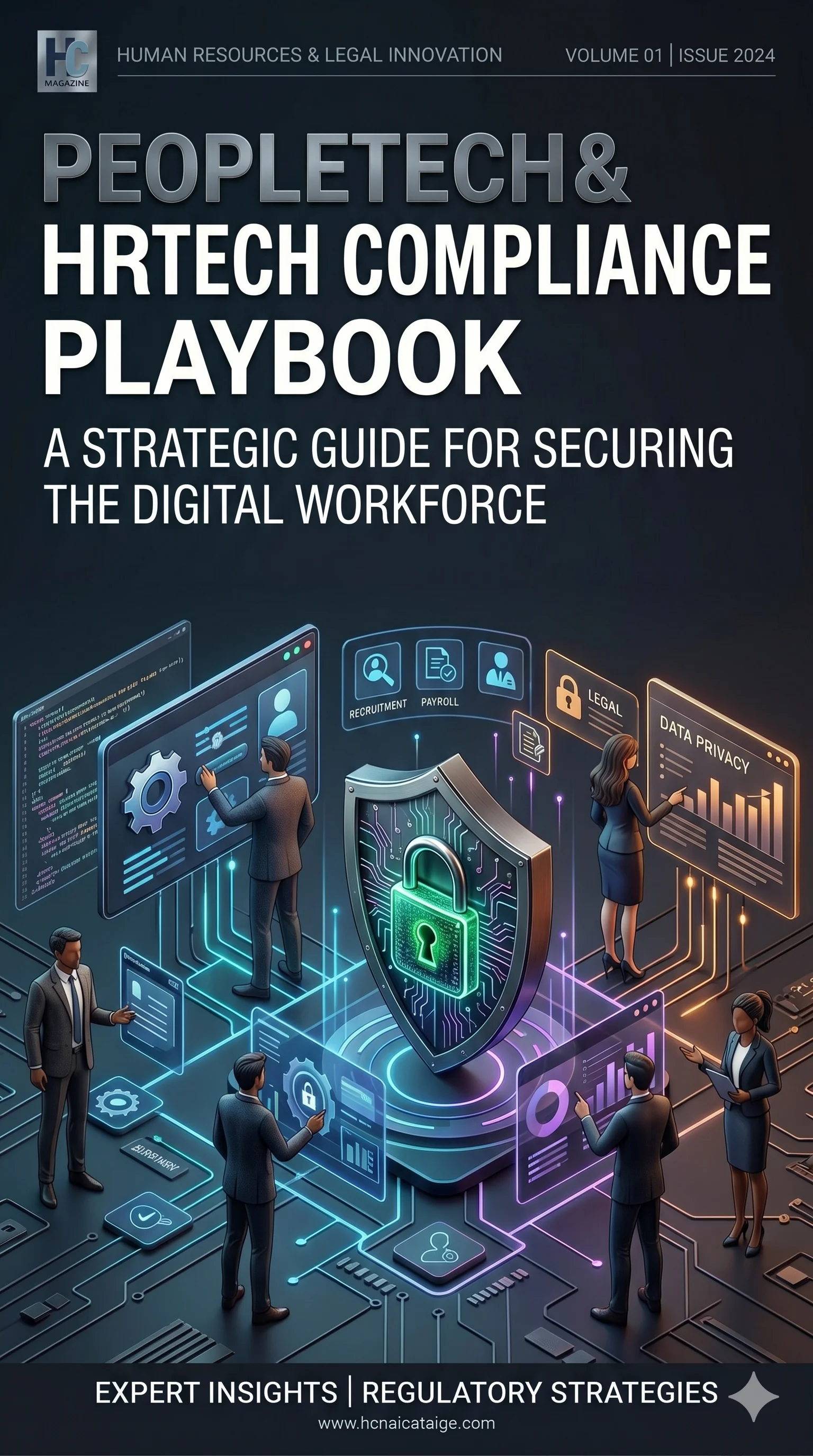
The PeopleTech & HR Tech Compliance Playbook
Workforce screening, candidate identity verification, ongoing employee monitoring, and AI-era hiring fraud defense for HR Tech platforms and enterprise HR teams.
Full name + work email required. We'll email you a copy.
Workforce screening, candidate identity verification, ongoing employee monitoring, and AI-era hiring fraud defense for HR Tech platforms and enterprise HR teams. The remote-first hiring landscape created a synthetic candidate problem. This playbook is the operational manual for solving it.
Six modules, each with a documented risk, the verification controls that defend against it, and the implementation checklist for operationalizing the controls — covering candidate identity at application, document authenticity and right-to-work, background screening and credentials, remote interview integrity, onboarding identity confirmation and equipment dispatch, and ongoing employee monitoring.
Module 1: Candidate Identity Verification at Application
The risk. Synthetic candidate fraud, where a fabricated or stolen identity is used to apply for a position, often to gain access to corporate systems, exfiltrate data, or commit insider fraud after hire. Documented in major banks, defense contractors, and FAANG-tier technology companies in the last 18 months. The North Korea IT worker fraud scheme, where DPRK operatives obtained remote technology jobs at hundreds of US companies using fabricated identities, made this category a board-level concern at every CISO function.
The control. Identity verification at application, before the candidate accesses the interview pipeline. The verification confirms the candidate is who they claim to be at the front door of the hiring funnel.
- Application portal triggers identity verification before the candidate receives interview scheduling links.
- deepidv ID document and selfie verification with NFC chip read where supported.
- Liveness detection and ensemble deepfake detection during selfie capture.
- Sanctions, PEP, and adverse media screen run as part of the same session.
- Verification result attached to the candidate file and visible to the hiring manager.
Module 2: Document Authenticity and Right-to-Work Verification
The risk. Forged identity documents, fabricated work authorization, and synthetic right-to-work documentation. The risk is amplified for cross-border hires, contractor relationships, and remote workforce scenarios where in-person document inspection is not part of the workflow.
The control. Document authenticity verification combined with right-to-work checks against authoritative sources. For US hires, this includes E-Verify integration where applicable. For UK hires, this includes the Home Office Right to Work share code system. For EU hires, this includes the relevant member state work authorization databases.
- Document authenticity verification on every identity document submitted, with template comparison and forensic artifact analysis.
- NFC chip read on chip-bearing passports and national ID cards.
- Right-to-work verification routed to the appropriate jurisdictional source.
- Document expiry dates captured and surfaced for re-verification scheduling.
- All documents stored in an encrypted vault with audit-defensible retention policies.
Module 3: Background Screening and Credential Verification
The risk. Fabricated credentials, inflated employment histories, undisclosed criminal records, and missing professional licenses. The HR consequence is bad-fit hires, turnover costs, and in regulated industries, examination findings. The compliance consequence in financial services, healthcare, and regulated industries is potentially individual liability for the hiring manager.
The control. Layered background screening covering criminal history, employment verification, education verification, and professional licensing where applicable.
- Background checks covering criminal history across all jurisdictions where the candidate has lived in the last seven years.
- Education confirmation directly with universities, colleges, and trade institutions.
- Employment verification with prior employers, including dates, titles, and reason for separation where the candidate has consented.
- Motor vehicle records for roles that involve driving.
- Credit checks for fiduciary roles, where permitted by jurisdiction.
- Professional license verification against state or national licensing authorities.
- Adverse media screening to surface reputational risk indicators.
- Sanctions and PEP screening to surface regulatory risk indicators.
- All findings documented in the candidate file with source citations.
Module 4: Remote Interview Integrity (Deepfake Defense)
The risk. Deepfake-enabled interview fraud, where a candidate uses real-time face replacement, voice cloning, or pre-recorded video injection to misrepresent their identity, technical skills, or English language proficiency during the interview process. Documented in technology hiring at scale in 2024 and 2025, with ongoing investigations into hiring fraud rings operating across multiple Fortune 500 companies.
The control. Deepfake detection on the interview platform itself, combined with periodic identity reconfirmation during the interview process and behavioral analysis of the candidate's interaction patterns.
- Interview platform integrates deepfake detection that runs on the participant video streams in real time.
- For Zoom, Google Meet, or Microsoft Teams interviews, deepeye Chrome Extension provides real-time deepfake detection across all three platforms.
- Periodic identity reconfirmation during longer interview sequences, with the candidate completing a brief liveness check at the start of each session.
- Behavioral analysis of the candidate's voice patterns, response timing, and communication style for inconsistency signals across multiple interviews.
- Final round interviews include an identity reconfirmation step before offer letter issuance.
- ProofCall voice clone detection on phone-based interviews and reference calls.
Module 5: Onboarding Identity Confirmation and Equipment Dispatch
The risk. Identity substitution between the candidate who completed the interview process and the person who shows up for day one. Equipment dispatch to a fraudulent address, leading to immediate corporate device compromise. Account provisioning to a synthetic identity that proceeds to act as an insider threat from day one.
The control. Identity reconfirmation at onboarding, address verification before equipment dispatch, and access provisioning gated on successful onboarding identity match.
- Day-one identity reconfirmation with the same identity verification flow used at application, comparing biometrics against the original session.
- Address verification before any corporate equipment is shipped.
- Initial system access provisioning gated on successful onboarding verification.
- IT security briefing includes deepfake awareness and reporting procedures.
- HR personnel files include the original verification artifact, the day-one reconfirmation, and any subsequent re-verification events.
Module 6: Ongoing Employee Monitoring
The risk. Insider threat from compromised, coerced, or replaced employees. Long-term insider fraud schemes that mature over years before detection. Account takeover of employee credentials by external attackers. Behavioral changes that signal disengagement, mental health concerns, or potential exfiltration risk.
The control. Continuous monitoring of employee identity, behavioral patterns, and external risk signals, with documented escalation procedures for anomalies.
- Continuous adverse media monitoring on all employees, with results surfaced to HR and security on a configurable cadence.
- Continuous sanctions and PEP screening, particularly for employees in regulated roles.
- Behavioral anomaly detection on employee system access patterns, with anomalies routed to security operations for investigation.
- Periodic identity reconfirmation for employees in high-risk roles, including executives, finance, IT administration, and customer-facing positions.
- Documented offboarding identity confirmation to ensure the person collecting final pay and references is the actual departing employee, not a substituted identity.
- Arbiter handles continuous monitoring and surfaces material changes for HR and security review.
Pull quote“Generic compliance frameworks miss the specific risks of synthetic candidate fraud, deepfake-enabled interview fraud, and the North Korea IT worker scheme. A dedicated playbook addresses these risks specifically.”
Operational Rollout in 90 Days
Days 1 to 30: Discovery and gap analysis. Map your current HR compliance controls against the six modules. Identify which controls exist, which are partial, and which are missing. Quantify your last 24 months of hiring fraud incidents, including any North Korea IT worker scheme exposure.
Days 31 to 60: Modules 1 and 4 first. Candidate identity verification and remote interview integrity. These two modules together close the front door against synthetic candidate fraud and deepfake-enabled interview fraud.
Days 61 to 90: Modules 2, 3, 5. Document authenticity, background screening, and onboarding identity confirmation. The compliance core.
Days 91 to 120: Module 6. Ongoing employee monitoring. The maturity layer that protects the institution across the full employee lifecycle.
Compliance Alignment
This playbook aligns with the Equal Employment Opportunity Commission guidance on the use of artificial intelligence in employment decisions, the Fair Credit Reporting Act for background screening, the General Data Protection Regulation for EU candidate data handling, the California Consumer Privacy Act for California candidate data, the UK Data Protection Act 2018 for UK candidate data, and the Office of Foreign Assets Control sanctions screening obligations applicable to all US employers.
For HR Tech platforms providing services to enterprise customers, this playbook also aligns with SOC 2 Type II expectations for service organization controls, the relevant ISO 27001 and ISO 27701 frameworks for information security and privacy, and the emerging IEEE 7000 series standards for ethical AI in human resource decision-making.
PeopleTech & HR Tech Compliance FAQ
- Why does HR Tech need its own compliance playbook?
- HR Tech operates at the intersection of identity verification, employment law, data privacy, and increasingly fraud prevention. Generic compliance frameworks miss the specific risks of synthetic candidate fraud, deepfake-enabled interview fraud, and the North Korea IT worker scheme that have emerged as material risks in the last 24 months. A dedicated playbook addresses these risks specifically.
- What is the North Korea IT worker scheme and is it still active?
- The DPRK IT worker scheme involves North Korean operatives obtaining remote technology jobs at US and other Western companies using fabricated identities, often with the help of US-based facilitators who handle the equipment and logistics. The FBI and Treasury Department issued advisories on the scheme in 2024, and ongoing enforcement actions through 2026 indicate the scheme remains active, with adapted tactics in response to defensive countermeasures.
- Are background checks still effective against synthetic identity?
- Background checks are necessary but not sufficient against high-quality synthetic identity. The synthetic identity often has a real Social Security number that passes basic database checks. The defense against synthetic identity at hiring requires layered identity verification, document authenticity checks, and biometric verification, not just background screening.
- How does deepfake detection work in a remote interview?
- Real-time deepfake detection runs on the video stream as the interview is happening, examining the candidate's video for the artifacts that generative models produce. Detection runs as a browser extension, a dedicated interview platform integration, or as a virtual camera filter that processes the stream before it reaches the recording layer. The hiring manager receives an alert if a high-confidence deepfake signal is detected.
- Is ongoing employee monitoring legal under GDPR and CCPA?
- Continuous monitoring of employee identity, sanctions status, and adverse media is generally permitted under both GDPR and CCPA, provided the monitoring is necessary for a legitimate interest, proportionate to the risk, and disclosed to the employee. The implementation should be reviewed by employment counsel for the specific jurisdiction and the specific monitoring scope.
Relevant Articles

Reality Defender Just Made Voice and Video Untrustworthy
Voice and video as compromised channels by design.
Apr 25, 2026

Verifus and the Industrialization of Deepfake Onboarding Fraud
What injection attacks expect to defeat in interview pipelines.
Apr 25, 2026

The Anatomy of a Modern Onboarding Attack
Stack-by-stack attack architecture and the seven defensive controls.
Apr 27, 2026

Synthetic Identity Fraud in 2026
How generative models build people who don't exist — and how to catch them.
Apr 26, 2026
What is deepidv?
Not everyone loves compliance — but we do. deepidv is the AI-native verification engine and agentic compliance suite built from scratch. No third-party APIs, no legacy stack. We verify users across 211+ countries in under 150 milliseconds, catch deepfakes that liveness checks miss, and let honest users through while keeping bad actors out.
Learn More