

The Loan Originator Compliance Playbook
Mortgage and consumer loan originator identity verification, AML screening, ability-to-repay documentation, fraud defense, and ongoing monitoring for the 2026 lending environment.
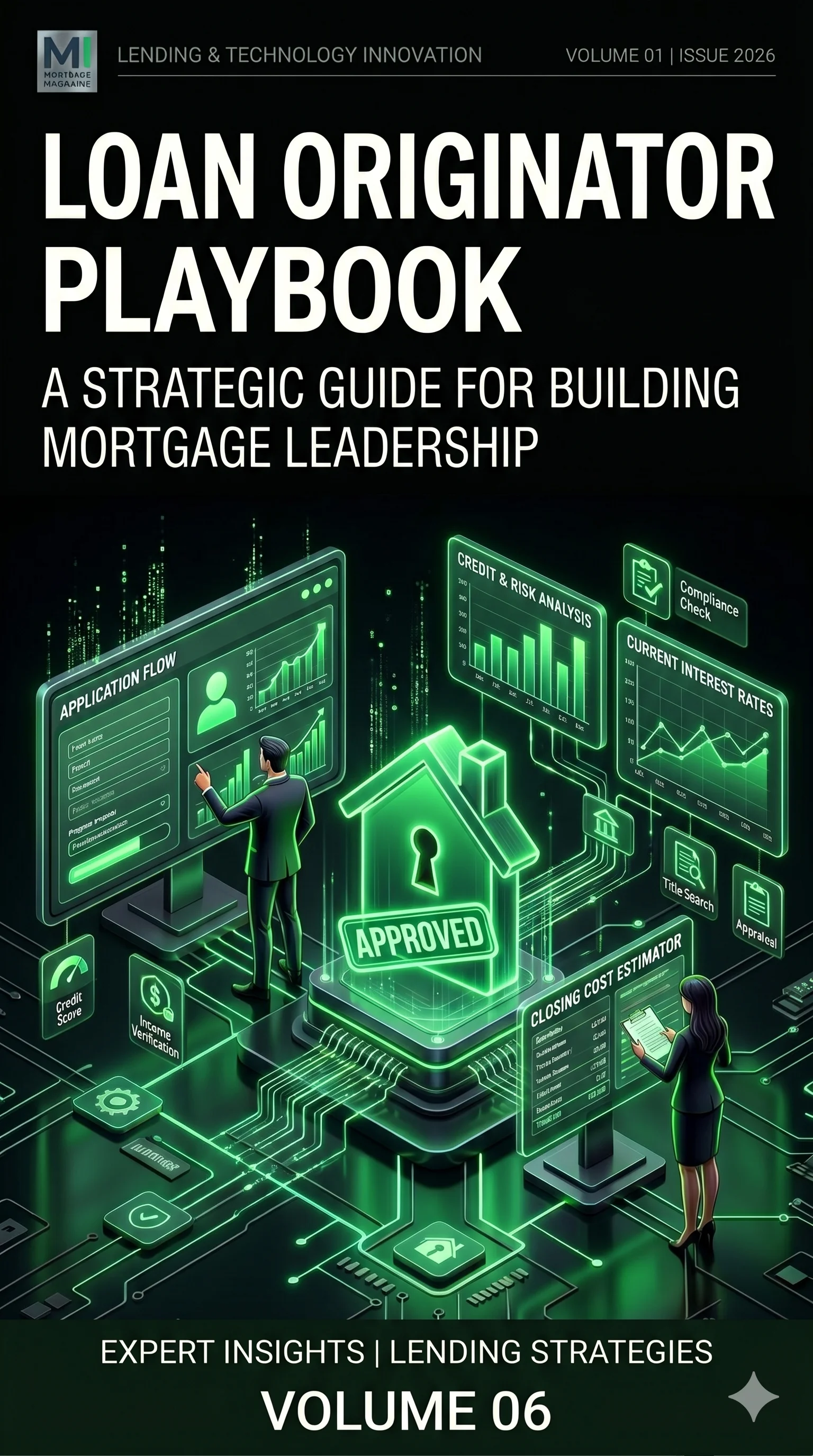
Full name + work email required. We'll email you a copy.
Mortgage and consumer loan originator identity verification, AML screening, ability-to-repay documentation, fraud defense, and ongoing monitoring for the 2026 lending environment. Synthetic borrower fraud, income fabrication, and deepfake-assisted application schemes are reshaping the loan origination risk profile.
This playbook is the operational manual for defending the loan file from application through payoff — covering borrower identity, income and employment verification, asset and reserve verification, document forensic analysis, AML and sanctions screening, closing and disbursement integrity, and ongoing borrower monitoring.
Module 1: Borrower Identity Verification at Application
The risk. Synthetic borrower fraud, where a fabricated or stolen identity is used to apply for a mortgage or consumer loan. The risk has grown in step with synthetic identity fraud generally, with mortgage and auto lending now identified as priority verticals for fraud-as-a-service operators. The bust-out moment for a synthetic borrower in lending is the funded loan; the recovery options at that point are minimal.
The control. Full identity verification at application, before any underwriting work begins. The verification combines document authenticity, biometric face match, liveness, and synthetic identity signal scoring.
- Borrower submits ID and selfie via deepidv verification flow at application intake.
- NFC chip read for chip-bearing documents where supported.
- Liveness detection and ensemble deepfake detection during selfie capture.
- Document authenticity verification with template comparison and forensic artifact analysis.
- Synthetic identity signal scoring against the application data, including SSN-name-DOB consistency, address history coherence, and phone-email metadata patterns.
- Verification result attached to the loan file with timestamp, biometric match score, and document authenticity score.
Module 2: Income and Employment Verification
The risk. Fabricated paystubs, falsified W-2s, manufactured employment letters, and false employer references. The risk has escalated as generative AI has reduced the cost and time required to produce convincing employment documentation. A 2024 Fannie Mae lender survey indicated that income misrepresentation is now the most frequently identified fraud type in mortgage loan reviews.
The control. Direct income verification through employer connection or payroll data provider, with document forensic analysis as a secondary control on any submitted income documents.
- Direct payroll connection via The Work Number, Plaid Income, or equivalent payroll data provider, where the borrower consents.
- Direct employer verification for employment confirmation, dates, and title.
- Financial screening on submitted income documents, including paystub authenticity analysis, W-2 verification, and tax return forensic analysis.
- Self-employed borrower documentation includes IRS tax transcript verification through the IRS Income Verification Express Service (IVES).
- 1099 income includes verification with the issuing entity where the borrower has consented.
- All income documentation reviewed for the synthetic identity signature, including the consistency of name and SSN across employer records.
Module 3: Asset and Reserve Verification
The risk. Fabricated bank statements, falsified asset documentation, and gift letter fraud. Bank statement fabrication is now low-cost and accessible through the same generative AI tooling that produces synthetic income documents. The ability-to-repay evaluation depends on accurate asset documentation.
The control. Direct bank account verification through aggregator connection, combined with document forensic analysis on any manually submitted statements.
- Direct bank account connection via Plaid, Yodlee, or equivalent account aggregator, where the borrower consents.
- Read-only access to account history for the period required by the loan program, typically 60 to 90 days.
- Asset verification covers deposit balances, transaction history, and inflow analysis to identify undisclosed deposits.
- Net worth verification for higher-value loan programs and accredited investor scenarios.
- Document forensic analysis on any manually submitted bank statements, including PDF metadata analysis, font consistency analysis, and arithmetic verification of statement totals.
- Gift letter verification with the donor's identity and the source of the gifted funds traced to a verified account.
Module 4: Document Forensic Analysis
The risk. Generative AI now produces convincing PDFs of bank statements, tax returns, paystubs, employment letters, and asset documentation. Template-based document checks pass these documents because the templates match. The fraud is in the second derivative.
The control. Document forensic analysis examining metadata, compression patterns, font rendering, and arithmetic consistency on every income, employment, and asset document submitted to the loan file.
- PDF metadata analysis on every submitted document, including author, software, creation date, modification date, and editing history.
- Font rendering analysis for consistency with the document's claimed origin.
- Arithmetic verification on any document that includes calculated fields, including paystubs, bank statements, and tax returns.
- Compression pattern analysis for signs of digital generation versus scanning of physical documents.
- Cross-reference of document content against authoritative sources where possible, including IRS transcripts for tax returns and direct employer verification for paystubs.
- All forensic findings logged in the loan file for audit defense.
Module 5: AML, Sanctions, and PEP Screening
The risk. Borrower or property transaction implicated in money laundering, sanctions evasion, or politically exposed person concerns. The risk is most acute in high-value mortgage transactions, cash-intensive borrower profiles, and transactions involving foreign nationals or trust structures.
The control. Layered AML screening at application, ongoing screening throughout the loan term, and enhanced due diligence for elevated-risk profiles.
- Sanctions screening against OFAC, UN, EU, HMT, and AUSTRAC lists at application.
- PEP screening for the borrower and any beneficial owners of trust or entity structures.
- Adverse media screening for reputational risk indicators.
- Source of funds documentation for cash-to-close amounts above program thresholds.
- Beneficial ownership documentation for entity borrowers, with each beneficial owner subject to full identity verification.
- Enhanced due diligence for foreign national borrowers, including verification of source of funds and source of wealth.
- Continuous re-screening of borrower and beneficial owners through loan term.
- All AML documentation logged in the loan file in compliance with Bank Secrecy Act recordkeeping requirements.
Module 6: Closing and Disbursement Integrity
The risk. Wire fraud at closing, where the borrower's funds are intercepted via spoofed wiring instructions. Identity substitution at closing, where the person signing the closing documents is not the verified applicant. Title fraud, where the seller's identity is falsified. Each of these risks now involves a deepfake-enabled vector.
The control. Out-of-band wire verification, identity reconfirmation at closing, and deepfake-resistant remote online notarization where applicable.
- Wiring instructions distributed only via secure portal, never via email.
- Borrower confirms wiring instructions by phone using a verified callback number, not a number provided in any email.
- Identity reconfirmation at closing using the same biometric verification flow as the application, with the closing-day biometrics matched against the application biometrics.
- For remote online notarization (RON), the platform integrates ensemble deepfake detection on the participant video.
- ProofCall voice clone detection on closing-related phone communications.
- Title verification confirms the seller is the owner of record on the title and that the seller's identity matches the documentation.
- All closing-day verification artifacts retained in the loan file.
Module 7: Ongoing Borrower Monitoring and Re-verification
The risk. Account takeover on the borrower's mortgage account. Fraudulent payoff requests redirected to the attacker. Equity-stripping schemes. Identity changes that would have triggered re-verification under the original loan terms.
The control. Continuous behavioral monitoring on the servicer's customer portal, periodic identity re-verification, and step-up reverification for any high-risk action.
- Behavioral biometric scoring on every login to the servicer portal.
- Step-up reverification triggered for: change of mailing address, change of payoff destination, change of payment method, equity line drawdown, account closure request, beneficiary change.
- Continuous adverse media and sanctions monitoring on borrower file.
- Reverification flow uses the same identity verification capabilities as the application, with biometric match against the original session.
- Anomalous behavior flagged to fraud operations within minutes.
- Arbiter's re-verification sub-agent handles trigger logic and routing.
Pull quote“The bust-out moment in lending is the funded loan. Detection has to happen before disbursement, because the recovery options after are minimal.”
Operational Rollout in 90 Days
Days 1 to 30: Discovery and gap analysis. Map your current loan compliance controls against the seven modules. Identify which controls exist, which are partial, and which are missing. Quantify your last 24 months of fraud losses by category. Review your last 12 months of repurchase requests for synthetic identity or income fraud signatures.
Days 31 to 60: Modules 1, 4, and 5 first. Borrower identity verification, document forensic analysis, and AML screening. These three modules close the front door against the highest-frequency fraud categories.
Days 61 to 90: Modules 2 and 3. Income, employment, and asset verification. The underwriting integrity layer.
Days 91 to 120: Modules 6 and 7. Closing integrity and ongoing monitoring. The full lifecycle defense.
Compliance Alignment
This playbook aligns with the requirements of the Bank Secrecy Act and its implementing regulations under 31 CFR Chapter X, the Truth in Lending Act and the ability-to-repay requirements under 12 CFR Part 1026, the Real Estate Settlement Procedures Act, the FinCEN Geographic Targeting Orders for residential real estate, the proposed FinCEN AML/CFT Reform NPRM for residential real estate transfers, the OFAC sanctions screening obligations applicable to all US lenders, and the Equal Credit Opportunity Act and Fair Housing Act fair lending obligations.
For Canadian lenders, this playbook aligns with the Proceeds of Crime (Money Laundering) and Terrorist Financing Act, FINTRAC reporting obligations, the Office of the Superintendent of Financial Institutions guidelines, and the relevant provincial mortgage broker regulations including the Financial Services Regulatory Authority of Ontario rules and the BC Financial Services Authority requirements.
Penalty Exposure
Mortgage and consumer lending compliance failures in 2024 and 2025 produced multiple eight-figure penalties for AML and ability-to-repay violations. The trend in 2026 is toward larger penalties tied specifically to identity fraud and income misrepresentation, as regulators direct more examination attention to the categories that AI tooling has accelerated. The CFPB, the OCC, and the FDIC have all signalled that synthetic identity exposure in the loan book is now a priority examination focus.
Loan Originator Compliance FAQ
- Why does loan origination need its own compliance playbook?
- Loan origination operates at the intersection of identity verification, AML, fair lending, and increasingly fraud prevention. Generic compliance frameworks miss the specific risks of synthetic borrower fraud, generative-AI-fabricated income documentation, and deepfake-enabled closing fraud that have emerged as material risks in the last 24 months. A dedicated playbook addresses these risks specifically.
- What is income fraud in the 2026 lending context?
- Income fraud now includes both traditional categories (misstated income, undisclosed obligations, fabricated employment) and AI-enabled categories (generative-AI-produced paystubs, W-2s, tax returns, and bank statements that pass template-based authenticity checks but fail forensic analysis). The defense requires direct income verification through payroll data providers and forensic analysis on any manually submitted documents.
- Are direct payroll connections always available?
- Direct payroll connection is available for the majority of US W-2 employees through The Work Number, Plaid Income, and similar providers. Coverage is incomplete for self-employed borrowers, contractors, and certain employer categories. Where direct connection is not available, IRS Income Verification Express Service tax transcript pulls and direct employer verification provide secondary controls.
- What is the synthetic borrower bust-out moment?
- The bust-out moment in lending is the funded loan. Unlike credit card synthetic identity fraud, which can be discovered through ongoing payment monitoring, mortgage and auto loan synthetic borrowers receive a lump-sum disbursement at closing. The detection has to happen before the loan funds, because the recovery options after disbursement are minimal.
- How does ongoing monitoring work post-funding?
- Post-funding monitoring covers behavioral patterns on the servicer portal, identity changes triggered by life events (address change, payment method change), continuous AML screening, and step-up reverification for high-risk actions including payoff requests and equity line drawdowns. The monitoring runs for the full loan term and provides defensive coverage against post-origination fraud schemes.
Relevant Articles

Synthetic Identity Fraud in 2026
Six-layer detection stack at onboarding and after.
Apr 26, 2026

The Anatomy of a Modern Onboarding Attack
Stack-by-stack architecture and the seven defensive controls.
Apr 27, 2026

Wire Fraud in Real Estate Closings
Step-by-step prevention for closing-stage attacks.
Apr 14, 2026

Six Weeks Until June 9: FinCEN Stablecoin Comment Window
AML/CFT reform with implications for residential real estate transfers.
Apr 26, 2026
What is deepidv?
Not everyone loves compliance — but we do. deepidv is the AI-native verification engine and agentic compliance suite built from scratch. No third-party APIs, no legacy stack. We verify users across 211+ countries in under 150 milliseconds, catch deepfakes that liveness checks miss, and let honest users through while keeping bad actors out.
Learn More