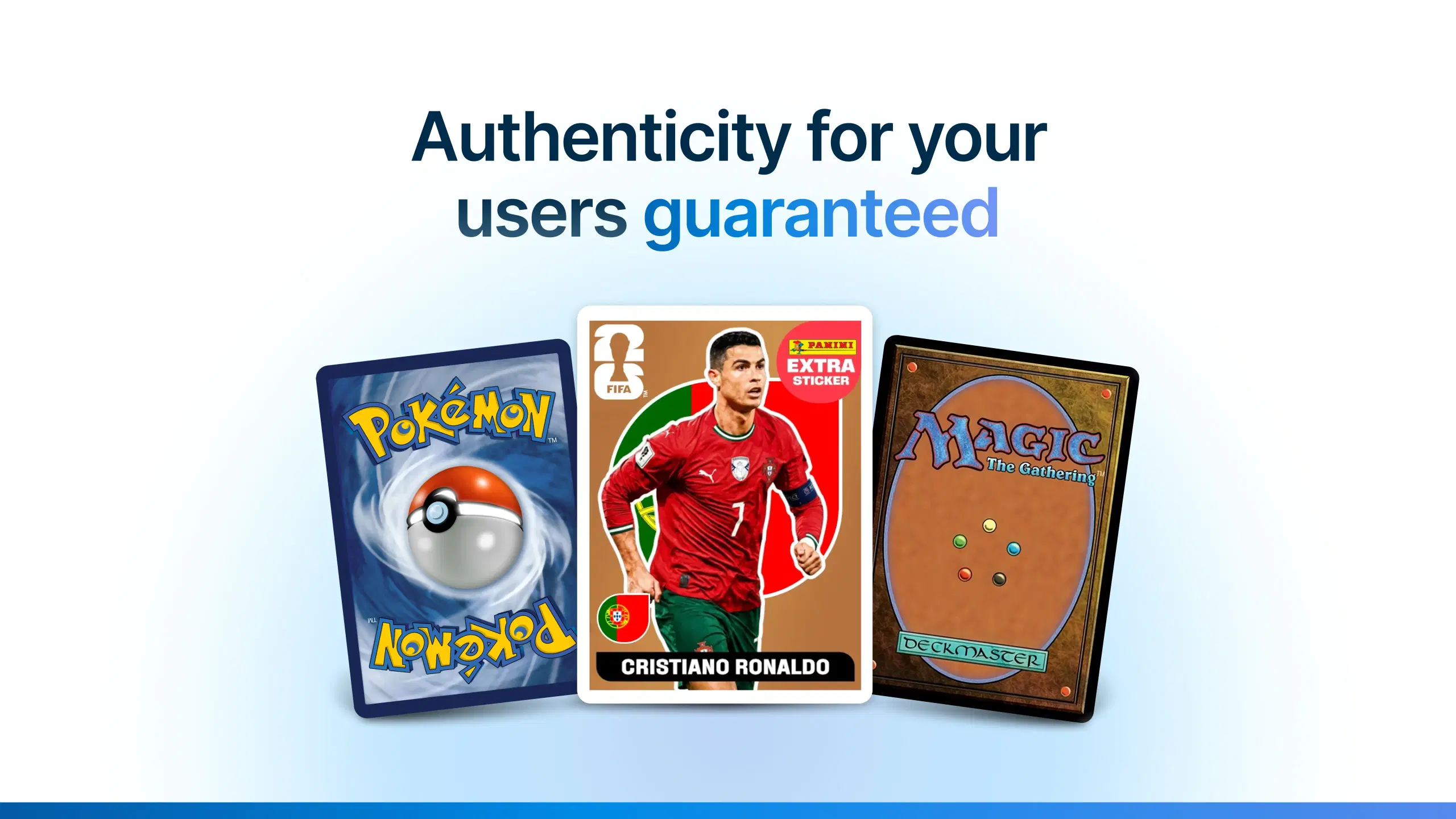
How to Sell Trading Cards Online Safely in 2026
Learn how to sell trading cards online safely in 2026: price with real comps, decide whether to grade, pick the right venue, avoid chargebacks, and get paid.
Sep 18, 202610 min
Read more

Sports card authentication explained: how PSA, Beckett, SGC, and CGC grading works, how to spot counterfeit, trimmed, and reslabbed cards and forged autographs, and how to verify sellers.
Sports card authentication is the process of confirming that a card is genuine, unaltered, and correctly graded, and that the person selling it is who they claim to be. Both halves matter. A Michael Jordan rookie or a Victor Wembanyama Prizm can carry a five or six figure price tag, and every dollar of that value invites a counterfeit, a trim job, a forged autograph, or a hijacked seller account. If you collect basketball, baseball, football, or soccer cards from Panini or Topps, you are transacting inside a market where fraud scales with price.
The numbers explain the pressure. The major authenticators graded more than 26 million cards in 2025, a roughly 32 percent jump over the prior year, according to reporting from Yahoo Sports. PSA alone estimates it intercepted fraudulent collectibles with a projected market value north of 200 million dollars in 2025, as Sports Collectors Daily documented. The sports trading card market itself was valued near 13.75 billion dollars in 2025 by Verified Market Research. Money that size draws organized fraud.
This guide covers the whole chain: how grading works across PSA, Beckett, SGC, and CGC, how counterfeit and trimmed cards get made, how forged autographs and fake patches slip through, how reslabbed and doctored holders fool a phone photo, and how modern marketplaces now verify both the card and the human on each side of the deal.
Grading assigns a numeric condition score, usually on a 1 to 10 scale, after a third party inspects centering, corners, edges, and surface. The grade drives the price, so the grade is the thing fraud targets. Four companies dominate.
One structural fact reshapes trust here. After acquisitions, PSA parent company Collectors now owns PSA, SGC, and Beckett, giving one corporate group roughly 80 percent of the market, as PreGradeCards reported. That consolidation makes cross-checking a cert against the official grader database more important than ever, because most slabs you encounter trace back to a handful of registries.
Suggested read: How to Sell Trading Cards Online Safely
Fraud against the card comes in layers, and the sophisticated operators stack several at once. A useful breakdown from Baseball.cards and Hobby Card Index maps the field.
Counterfeiters keep improving. Sports Collectors Daily notes that sophisticated fakes now use period-correct stock and even donor cards from the same set to defeat casual inspection. The defense is high-resolution imaging and provenance, not the naked eye.
You can catch most alterations with a loupe, a scale, and good light.
Suggested read: Trading Card Fraud, Counterfeit Slabs, and Reslabbing
Autographs are quick to fake, expensive to verify, and easy to sell to a buyer who has no genuine example to compare against. That asymmetry is why forgery persists. The scale can be staggering: in 2025, memorabilia dealer Brett Lemieux admitted to forging millions of autographs and holograms over two decades, with sales figures reported above 350 million dollars, as covered in reporting aggregated by MTLMRK.
Three third-party services dominate autograph authentication, and each publishes a verifiable cert database.
A witnessed autograph, where the authenticator was physically present at the signing, carries more confidence than one authenticated years later by handwriting analysis alone. The Beckett guide to authenticating autographs is a solid primer. Whatever the label says, run the cert number yourself before you pay, because forged holograms and reused stickers are a known scam.
The counterfeit slab attacks the one thing collectors trust most, the grade. Fraudsters bust a genuine card out of a real holder and reseal a cheaper, trimmed, or entirely different card inside, or they manufacture a counterfeit case outright. PreGradeCards catalogs the red flags: misaligned labels, wrong fonts, missing or flat holograms, poor case construction, and a card inside on stock that does not match the era.
Reslabbing is the subtle version. The case and hologram can be authentic because the holder is real, so the giveaway is a mismatch between the label's stated card and the physical card, or between your card and the grader's on-file reference images. Always compare the actual card to the cert lookup photos, not just the label.
Every major grader publishes a free cert database. Type the number from the label and confirm the returned card matches what you hold.
| Grader | Cert lookup | What to confirm |
|---|---|---|
| PSA | psacard.com/cert | Grade, population, and any TrueView images |
| Beckett | beckett.com/grading/card-lookup | Serial number, grade, card details |
| SGC | gosgc.com/card-verification | Holder matched to record |
| CGC Cards | cgccards.com/certlookup | Encapsulation and reference images |
If the number returns nothing, or returns a different card, stop. That is a fake label or a swapped card. After the lookup, inspect the physical slab: genuine cases are ultrasonically welded with clean, uniform seams, while reslabbed holders show glue, scratches, cloudiness from reheating, or a lip that does not sit flush.
Suggested read: Selling Graded Cards Through Consignment and Escrow
Human graders miss things, and the best counterfeits are built to beat human inspection. Computer vision changes the economics. AI can compute centering to the pixel, analyze each corner and edge independently, and flag print defects in seconds, as the Ximilar overview of AI card grading explains. Systems trained on ink texture and gloss can catch pixel-level print variations invisible to the eye and detect a trimmed edge instantly.
That same image-analysis capability is what makes marketplace-level authentication practical at scale. Instead of shipping every card to a grader, a marketplace can screen listing photos for signs of counterfeiting, alteration, and reslabbing at the point of listing, then escalate the suspicious ones. This is the shift from authenticating one card at a time to validating an entire catalog of listings continuously.
Object fraud gets the headlines, but transaction fraud drains more wallets. Non-delivery, empty-package switches, and chargebacks live in how the deal is structured, not in the card. The FBI Internet Crime Complaint Center logs non-delivery and non-payment among the most common consumer complaints every year, and collectibles sit squarely in that mix. Before any high-value purchase, the FTC's advice on avoiding online shopping scams and the Better Business Bureau's scam resources are worth a read.
The most damaging scams never touch the card. They target the person. A hijacked account with years of five-star feedback is a weapon, because buyers trust the reputation and skip their own checks. Triangulation fraud sits next to it: a scammer buys your listed card with a stolen credit card, you ship in good faith, and weeks later a chargeback lands. You lose the card and the cash.
The defense is identity, not feedback. Feedback measures history; identity verification measures who is actually at the keyboard right now. Regulation agrees. The FTC's INFORM Consumers Act requires online marketplaces to collect and verify identity and bank details from high-volume third-party sellers, and the EU Digital Services Act imposes know-your-business-customer duties across Europe.
deepidv is a verification engine and agentic compliance suite built for exactly this two-sided problem. It does two jobs at once. It verifies the human on both sides of a trade through identity, liveness, deepfake and AI-face detection, and 1:N matching to catch banned sellers evading a ban, and it validates the product itself, screening listing images for counterfeit, altered, trimmed, and reslabbed cards and fake grading slabs. See how it maps to collectibles on the verification for marketplaces page.
Three agents do the continuous work static reputation cannot.
Under all of it, deepidv's core verification technology and deepeye deepfake detection confirm identity and catch synthetic media at the door, whether it comes from a person or an AI agent transacting on someone's behalf. You can review coverage and plans on the pricing page, and the mechanics of the checks themselves on the verification page.
Suggested read: Peer-to-Peer Marketplace Safety and Verification
Run this before you send money or ship a card. It takes minutes and stops most fraud.
Suggested read: Building Trust on a Peer-to-Peer Marketplace
Sports card authentication is confirming that a card is genuine and unaltered, that any grade or autograph on it is legitimate, and increasingly that the seller offering it is a verified real person. It combines a cert lookup on the grading company's database, a physical inspection of the card and slab, and identity verification of the seller. All three layers matter, because a real card can be sold by a fraudulent account and a fake card can carry a convincing label.
Enter the certification number from the label into the grader's free online lookup: PSA, Beckett, SGC, or CGC Cards. Confirm the returned grade, card details, and any reference images match the card in your hands. Then inspect the physical slab for clean welded seams, a genuine shifting hologram, and a straight, centered label. A cert that returns nothing or a different card is a clear sign of a fake.
Compare the print structure under magnification, since genuine cards show a consistent dot rosette that counterfeits rarely match. Measure the card against standard dimensions, because a short measurement suggests trimming, and check edges for a too-clean or freshly white cut. A UV light can reveal features counterfeits do not replicate. When the price is far below market and the seller resists close photos, treat it as a red flag.
Run the certification number through the issuing service's database: PSA/DNA, JSA, or Beckett Authentication. Favor witnessed autographs, where an authenticator was present at the signing, over items authenticated later by handwriting analysis alone. Because forged holograms and reused stickers exist, always verify the cert yourself rather than trusting a photographed label.
Reslabbing is cracking open a genuine graded case, swapping in a lower-value or altered card, and resealing it. Because the case and hologram can be authentic, casual checks pass. The giveaway is a mismatch between the label's stated card and the physical card, or between your card and the grader's on-file reference photos. Always compare the actual card to the cert lookup images, not just the label.
Modern marketplaces tie each seller account to a verified real person or business using document and liveness checks, not feedback alone, and regulations like the INFORM Consumers Act require verifying high-volume sellers. Platforms then re-verify when payout details change and monitor for account-takeover behavior. deepidv provides this as one integration that verifies buyers and sellers while validating their cards on both sides of the transaction.
Go live in minutes. No sandbox required, no hidden fees.
Learn how to sell trading cards online safely in 2026: price with real comps, decide whether to grade, pick the right venue, avoid chargebacks, and get paid.
Learn how to sell graded cards safely: consignment houses and auctions, how escrow protects both sides, payout timing, and why platforms verify you first.
A founder's guide to peer-to-peer marketplace trust and safety: tiered onboarding, seller vetting, 1:N ban-evasion defense, escrow, disputes, and INFORM/DSA duties.