
TCG Marketplace Fraud in 2026: The Seven Scams to Stop
Fake slabs, cloned cert numbers, resealed boxes, ban evasion. The seven trading card scams hitting marketplaces in 2026, with data from PSA, CNN and the DOJ.
Sep 28, 202611 min
Read more

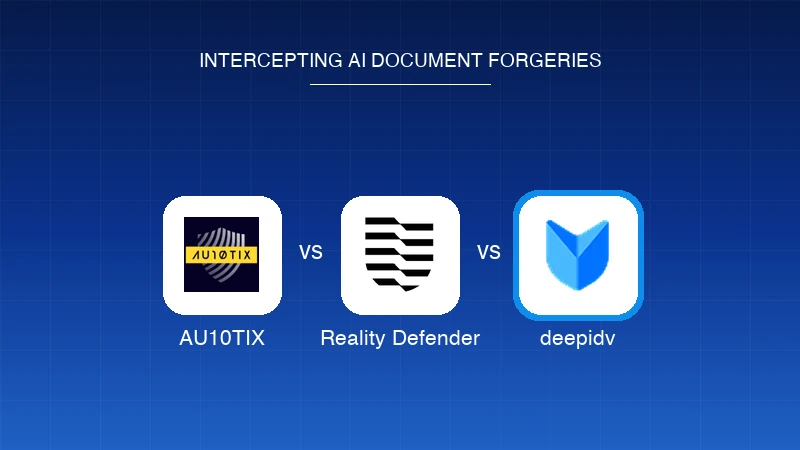
An operational engineering analysis evaluating deepidv, AU10TIX, and Reality Defender against synthetic identity documents and 244% forgery spikes.
As low-cost AI document generators turn a convincing forged passport into a fifteen-dollar purchase, the vendors that stop them are the ones that inspect hardware signal provenance rather than pixels, and deepidv, the automated verification engine and agentic compliance suite, was built for exactly that inspection. With forensic data confirming digital document forgeries have surged 244% year over year due to low-cost AI document generators, enterprise security teams must deploy layered defenses that verify where a document capture came from, not just how it looks.
The economics have inverted. A forgery that once required a skilled operator and specialized equipment is now generated on demand by an autonomous agent, complete with valid barcode payloads and sub-pixel security overlays. When supply is that cheap, volume defense fails, and detection has to move to a layer the generator cannot fake: the physical origin of the capture and the cryptographic chip inside the genuine document.
Optical character recognition was built to read the fields on a genuine document, not to prove that the document is genuine. Modern generative software produces images with pixel-perfect security overlays, correctly formatted MRZ lines, and barcode payloads that decode to internally consistent data, so a flat visual check finds nothing wrong. The forgery passes because it satisfies every property the OCR layer knows how to test.
Hardware signal provenance changes the question the system is asking. Instead of grading the image, deepidv establishes that the capture came from an authentic camera sensor and reads the NFC verification chip embedded in ICAO-compliant passports and national IDs to confirm the issuing authority's signature. A generated image has no chip and no genuine sensor origin, so it fails at a layer no amount of visual polish can satisfy. This is the architectural distinction that separates a document that looks real from a document that is real.
Suggested read: Digital Document Forgeries Surge 244% as AI Fraud Agents Target Global ID Cards
Book a 15-minute walkthrough. No slides. Just the product running on your use case.
Book a DemoThe objection to stronger document defense is always friction, and it is fair, because every added step in onboarding costs conversions. deepidv answers it by making the hardware checks passive: the device attestation handshake and the NFC read run inside a single capture moment and return within the sub-150ms boundary, so a legitimate applicant on a genuine device never sees an extra prompt. The heavy path only appears when the passive signals surface an anomaly.
This is the same defensive shift now reshaping enterprise verification more broadly. Our analysis of hardware signal provenance traces how anchoring identity to physical silicon, rather than to visual appearance, is becoming the mandatory baseline for stopping AI fraud agents. Document authentication is simply the first surface where that shift becomes unavoidable, because the generators got cheap there first.
Because modern generative software creates pixel-perfect sub-pixel security overlays and valid barcode payloads that easily pass flat visual OCR checks. OCR is designed to read a document's fields, not to prove the document is authentic, so a synthetic image that satisfies every visual property clears the check while never having existed as a physical credential.
It is the practice of confirming that a document capture originated from an authentic physical camera sensor and, where available, reading the cryptographically signed NFC chip inside the credential to validate the issuing authority. It shifts detection from analyzing how the document looks to establishing where the capture and the credential came from, which a generated image cannot satisfy.
NFC verification reads the embedded microchip inside an ICAO-compliant passport or national ID and validates the issuing sovereign's cryptographic signature on the stored data. An AI-generated image has no genuine chip to read, so the forgery fails the chip-attestation step regardless of how convincing the printed surface appears.
No. The device attestation handshake and NFC read are passive and edge-computed, returning within the sub-150ms execution boundary, so a legitimate applicant on a genuine device never sees an added step. Additional verification is reserved for sessions where the passive signals reveal an anomaly, which keeps the honest majority moving without friction.
Go live in minutes. No sandbox required, no hidden fees.
Fake slabs, cloned cert numbers, resealed boxes, ban evasion. The seven trading card scams hitting marketplaces in 2026, with data from PSA, CNN and the DOJ.
A guide to trading card fraud: counterfeit slabs, reslabbing, trimmed cards, non-delivery and triangulation scams, and how to authenticate a graded slab.
A practical peer-to-peer marketplace safety guide: spot overpayment, fake-payment, and off-platform scams, and how identity verification protects both sides.